
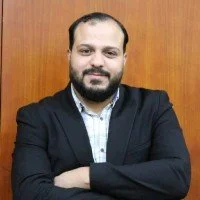
Zakaryah Khaled al-Fageh
Pronouns: He/Him
Organisations: Afaq Al-Hiwar Foundation
Country of origin: Libya
Profile
Zakaryah Khaled al-Fageh is one of the many eyewitnesses of the 2011 Libyan Revolution. The conflict led to the destruction of his hometown, Sirte, and the displacement of millions of people. Although Zakaryah first studied Civil Engineering, he decided to concentrate his career on peacebuilding after the start of the civil war in Libya. He focuses on reducing tensions in communities through sports and community initiatives. In 2019 Zakaryah established his own initiative – the Afaq Al-Hiwar Foundation – which focuses on the local participation of young people in peace discourse. The organisation empowers youth to participate in civil work with international non-governmental organisations and to implement projects specialised in social cohesion while engaging as many groups from within society as possible. For example, between December 2019 and September 2021, the organisation trained 40 young men and 20 young women in the basics of debate. They also held eight community dialogue peacebuilding sessions that included numerous groups, including women, civil society organisations, tribal leaders, the Sirte Municipal Council and the governmental sectors of Sirte. The Afaq Al-Hiwar Foundation is currently committed to implementing a conflict analysis project in the city of Sirte, funded by the United Nations Development Program (UNDP). Zakaryah said he considers himself one of the young leaders in the city of Sirte, and one of the most prominent supporters of peace and national reconciliation in Libya.
Story
‘A real gun has been pointed at my head at least three times since the revolution. Surviving death has become a normal thing for us,’ said Zakaryah Khaled al-Fageh. The people of Sirte and the rest of Libya now live in a war-torn society, where peace is not enjoyed by most. When the Libyan civil war broke out, Zakaryah saw his childhood vanish, and the lives of many innocent people taken away. He then decided to focus on peace initiatives, and eventually founded the non-governmental, non-profit Afaq Al-Hiwar Foundation that seeks to spread the culture of dialogue and debate among young people. ‘I am determined to change things, and the reason is because it was often the youth who died in these armed conflicts, while the ones who prospered were the politicians. So I decided to take a risk and enter the field of peacebuilding,’ Zakaryah said.
The goal of Zakaryah’s organisation is to empower young people both politically and economically, train them in the basics of debate, and then invite them to participate in the dialogue sessions with government officials. He said this, however, is easier said than done. Funding is limited, and most of it is designated to bigger cities in Libya, excluding those with a smaller population such as Sirte. Moreover, Libyan governmental laws impede civil work and limit access to external funding. There is social pressure too, as civil society organisations are often seen as unable to solve actual problems. On a more personal level, Zakaryah said he suffers instability, with no guaranteed source of income. ‘I am currently struggling to survive and live a decent life in a country that has collapsed all its institutions,’ Zakaryah said. His parents are on his mind in these turbulent times – ‘I have had their support from the beginning. They are my true source of inspiration.’
Zakaryah helped young people engage in debates and discussions about peace with various communities across Libya. He and his team also established a strong relationship with the Mayor of Sirte, and they now work closely with local authorities. Still, he considers all he has done to be merely a drop in the ocean. ‘The peacebuilding process will need another ten years, because the reconstruction process is far more complex than the demolishing was,’ he said. ‘However, I believe that change will come from within, and perhaps one day I will invite you to visit the city of Sirte after stability and peace have been established.’